Monday, July 12, 2010

Royal Story Time

From last night's Jezebel Open Thread:


Our first royal story tonight involves the late Queen Elizabeth, the Queen Mother.
During her final years, Elizabeth watched a lot of television. One of her favorite shows was Da Ali G. Show, from Sacha Baron Cohen. Only the first season aired before her death, but she really got into it.

Da Ali G. Show was where Cohen first debuted his characters Borat and Bruno, both of whom later went on to star in their own blockbuster films.

Elizabeth's favorite was the title character, Ali G., who was meant to be a suburban White guy obsessed with rap and hip-hop culture who claimed to be black and used outdated hip-hop slang terms. Elizabeth, then 100, thought Ali G.'s antics of tricking public figures into humiliating themselves were really amusing. She also loved his catch phrases and mannerisms.

One Christmas, she regaled her family with her Ali G. impersonation, after being egged on my her great-grandchildren. She even attempted his famous fake "accent" and repeatedly clicked her fingers (Ali's trademark) and told her family "Respec'!" before telling them "Any good parties, invite me down!"

Oh, and Jimmy Carter onced kissed her on the lips. She was not amused.


Our next story involves an even more badass old lady, also a Queen, and also named Elizabeth.

In December 1597, Elizabeth, then 64, met with her French ambassador.

She was attired in an ornate silver, red, and white gown. There was just one little issue; the entire front of it was open. So you could see "the whole of her bosom" as the ambassador himself put it.

" Her bosom is somewhat wrinkled as well as one can see for the collar that she wears round her neck, but lower down her flesh is exceeding white and delicate, so far as one could see."
-Andre Hurault, the French Ambassador

Elizabeth Tudor was a badass until the end. Furthermore, she kept opening the front as if she was hot, just to make sure he got a peak. Or maybe she just didn't care what he saw; she was the Queen after all and he was just some French guy.

She did make sure she had a wig with gold and silver spangles and pearls on before she would see him, though. How Gaga of her.


Our next story involves Edward VII, and his mistress Alice Keppel. Alice was one of several mistresses Edward had, but in his later years she was the favorite.

Once, at a formal dinner party, a Hungarian Countess was making small talk with the man seated at her right.

"Oh, how is your name pronounced?" She asked him.

"Kep-el." He said.

"How strange! You have the same name as the king's mistress!"

The unfortunate dinner guest was Alice's husband.

Fun fact: Alice's great-granddaughter was Camilla Shand, mistress and later wife to Prince Charles.


Here is a great story, likely a myth, that was most famously spread in regards to the not-yet-King Edward VII and Lillie Langtry, one of his mistresses and a famous actress. It has also been spread about other 19th and 20th century royal couples, which is why I question its accuracy. Still pretty amusing, though.

A prominent British newspaper had a box for announcements at the top of their front page. One week, they had printed alone in the box one sentance.
"There is nothing whatsoever between the Prince of Wales and Mrs. Langtry."

Readers were perplexed by the blatent denial; the papers ususally liked to have a bit of fun with their heir. But careful readers noticed exactly one week later in the same spot of the same paper, was another brief message.
"Not even a sheet."


George III is known for two things: being mad and losing the American colonies. This story is about the former.

King George was once riding in his carriage through Windsor Great Park and he suddenly ordered his driver to stop. The driver obliged him, and George got out and went over to an oak tree and put out his hand and shook one of its branches. The driver watched on amazed for several minutes while George talked to the tree and carried on a conversation. When he was done, George got back into the carriage. The Driver looked over at him, confused.

Turns out George thought the tree was the King of Prussia.

Naturally, if you ask Prince Charles (George's biggest fanboy) about that story, he'll say it didn't happen. But what fun is he?

Sunday, July 11, 2010

Victoria and Albert


There are only five royal married couples ever I feel totally certain had great romances. Victoria and Albert are one of them.
Though Victoria constantly wrote, particularly in regard to her daughters, that marriage was a horrible thing, that was more about her dislike of babies (she had nine) than her husband. She also felt that her and Prince Albert were special and had a great and magical love that no one else would ever understand.

"I feel sure that no girl would go to the altar if she knew all."
"When I think of a merry, happy, free young girl - and look at the ailing, aching state a young wife generally is doomed to - which you can't deny is the penalty of marriage."
-Victoria on marriage

Victoria and Albert were first cousins. They were originally set up by their mutual uncle Leopold of Belgium, but after one meeting when they were in their late teens, they fell in love. Or at least Victoria did, Albert's feelings may have taken longer to develop. At eighteen Victoria had become Queen, so she was the one who had a propose to him because she outranked him. He immediately accepted.

"His purity was too great, his aspiration too high for this poor, miserable world! His great soul is now only enjoying that for which it was worthy!"
"None of you can ever be proud enough of being the child of SUCH a Father who has not his equal in this world -- so great, so good, so faultless. Try, all of you, to follow in his footsteps and don't be discouraged, for to be really in everything like him none of you, I am sure, will ever be. Try, therefore, to be like him in some points, and you will have acquired a great deal."
-Victoria on Albert

Victoria quickly became pregnant after their wedding. They would have nine children total. I was on a few weeks ago about her feelings towards "unfortunate Leopold" but all of her children weren't exactly adored.

"An ugly baby is a very nasty object - and the prettiest is frightful."
-Victoria on babies

Of her nine children, her second child and eldest son, Edward Albert, known as Bertie, was her least favorite.

"I never can, or shall, look at him without a shudder"
-Victoria on Bertie

Bertie was a womanizer who drank and partied and generally acted unsuitably. Victoria also thought he was ugly. Which must have been some curse of fate, because as you can see from the above photo, his parents were the Brad and Angelina of their day.

"For a man to strike any women is most brutal, and I, as well as everyone else, think this far worse than any attempt to shoot, which, wicked as it is, is at least more comprehensible and more courageous."
-Victoria on domestic violence and why, if you're going to abuse your wife, you should do it with a gun

Prince Albert died at age forty-two, and Victoria totally lost it. She went into mourning and stayed there for the rest of her life. She became so reclusive that everyone was fed up with her and wanted to end the monarchy. Her son's womanizing with half the married actresses in London while his wife Alexandra looked the other way didn't help.

"I would venture to warn against too great intimacy with artists as it is very seductive and a little dangerous."
-Victoria on artists

Queen Victoria was to some extent brought out of her exile by John Brown, her Scottish manservant. Whether or not she ever got under his kilt is a subject of great debate. Victoria was not as much of a prude as people think when it came to sex. In face, attitudes toward sex in the era that bear her name weren't nearly as oppressive as everyone thinks. Certainly conservative by today's standards, but the upper classes still got into all kinds of trouble and weren't exactly secretive about it.

"The important thing is not what they think of me, but what I think of them."
-Victoria on other people

Victoria wasn't exactly a liberal, though. She was kind of the opposite. But she was certainly a decent enough lady, particularly compared to her cousin Leopold II of Belgium.

"I am most anxious to enlist everyone who can speak or write to join in checking this mad, wicked folly of "Women's Rights," with all its attendent horrors, on which her poor feeble sex is bent, forgetting every sense of womanly feelings and propriety. Feminists ought to get a good whipping. Were woman to "unsex" themselves by claiming equality with men, they would become the most hateful, heathen and digusting of begins and would surely perish without male protection.I love peace and quiet, I hate politics and turmoil. We women are not made for governing, and if we are good women, we must dilike these masculine occupations."
-Victoria on feminism

Here's a funny story: a royal hanger-on once was having dinner with Queen Elizabeth, the Queen Mother, and she described finding in the archives of Windsor Castle a document proving a secret marriage between Victoria and John Brown. When asked what she'd done with it, the Queen Mother told her dining companions she'd burned it, of course. Supposedly several people heard her tell this story, but it's not definitely true given both hangers-on and the late Queen Mother have never been known for their honestly.

P.S.
That quote on feminism was used on a men's rights website. With this commentary:

"How could she see today's reality from over 100 years in the past? I especially like the part about women becoming hateful, heathen and disgusting. You would have to be that way to hate men and abort your baby without reason."

Seriously, google it, it's totally for real!

Thursday, July 8, 2010

Prince John


^Prince John and his brother Prince George.

John was the youngest son of George V and Mary of Teck. He had epilepsy and possibly autism, too. It's hard to know as the details of his condition were kept very quiet.

He was close to his brother Prince George, but the younger two children were kept fairly separately from the older ones and as such John didn't really have that much of a relationship with the rest of his siblings. He would've gotten to know them better if he'd lived longer. John was tutored privately, and was kept away from people outside his immediate family in his early years. Except for nannies, of course. The people who did know him commented that he would often play pranks and mess around in the palace. He got away with a lot more than the rest of the children could. He would make very unusual comments to people they'd remember years later.

When John was eleven he was sent to live separately from the rest of the family on a farm. That was around the same age his older brothers had been sent to military school. In the farm house John had his own staff and was allowed more fresh air and freedom than he had in the palace. His grandmother, mother, and brother George often visited him. He had some friends and played in the gardens. He certainly missed his family, but it wasn't like they kept him locked up in the attic.

I do not like Queen Mary; I think she was a pretty horrible mother to all of her children and a not particularly nice person all around. But she really doesn't deserve the flack she gets for Prince John.

Honestly, from what I've read, she loved him and spent more time with him than she did some of her "normal" children. She sent him away, but she sent all of her other sons away at around the same age to boarding schools and she visited John more than she probably ever visited her other sons. Also, it wasn't entirely her decision what happened to John. I don't think she liked having her children around either way. In his memoir her oldest son Edward said that usually the only time he ever saw his mother as a child would be for an hour in the evenings when she was dressing for dinner. She would have her children sent up to her room and talk to them and teach them crafts and things, and then they would be taken away by the nanny and she wouldn't see them until the next day.

People during that time period were embarrassed of disabled children, particularly the upper classes. Queen Elizabeth, the Queen Mother, had an older brother who had two mentally challenged daughters he sent to an institution as teenagers. After that they were forgotten and the family told people they were dead.

John died at age thirteen in early 1919. His death was reported in the papers, but it was not a big story. The really bizarre thing is how after that he was basically forgotten. As a child, he had been mentioned as a member of the family; there were pictures of him sometimes with his siblings. But after he died, he was written out. All of a sudden the family only had five children. Official family trees were published for the coronation of George VI and the weddings of Princess Elizabeth and Princess Margaret. John was not included. His mother didn't talk about him much after he died. His grandmother Queen Alexandra did sometimes, but she died six years later. Prince George was the only relative who made significant efforts to keep his memory alive.

That's the really weird thing about this story. It shows one of the nastier elements of The Firm. Before he died, John was removed from the public eye. After his death, John as forgotten. No monuments and a very small funeral. I don't believe his name was mentioned in the obituaries for his parents; if it was it was only a fleeting reference. His name was considered bad luck so none of his relatives named children for him.

People completely forgot he'd ever existed until nearly eighty years after he died. In 1998 there was a big auction of the possession of the Duke and Duchess of Windsor. Some of the items included a large box of royal family photographs. There were pictures of John included. When the press were covering the auction, someone saw those and began to wonder "who was this kid?" and it led to an article and the publication of the photos in the British press. Of course the article was rather sensationalist; about how John had been locked away. Which wasn't exactly the case, but it made sense because most royal watchers had never heard of him at all. He wasn't included in many books documenting the family and when he was there was only a brief mention of his name and that he was sick. Certainly no one would have recognized him from the photos.

That press attention led to "The Lost Prince" miniseries which led to John's story getting more attention.

***This is actually something I posted on Jezebel and other places a few weeks ago but forgot to add here so I guess if you follow the blog you might not have seen it***

Wednesday, July 7, 2010

Never read the comments

The royals have been in the news a lot in the last month. I love going on google news and reading different articles and comments on certain stories.

While not reaching Youtube comment levels of stupidity, the average entertainment or political blog comment seems to have been written by someone between the ages of eight and twelve. Jezebel is a good exception, but I can't pretend stuff on there doesn't sometimes piss me off. Many royal blogs have the occasional intelligent comment too. I've also noticed local blogs often have more intelligent comments. Perhaps because people know where you live?

Either way, I have not been impressed over all.

There are three types of stories with comments I have seen recently that made me want to bang my head against my desk:

1. In response to the Queen's visit to Canada:
-Nasty and often sexist insults hurled at the eighty-four-year-old Queen.
-People bringing Diana into it. Some love her and some hate her. She has nothing to do with Queen Elizabeth visiting Canada.
-Rabid monarchists speaking of H.M. as though she was an other-worldly saint and getting into fights with those who disagree.

2. In response to Madonna's Wallis Simpson movie:
-"u no she was a nazi, right? i read it on wikipedia!!!"
-Assuming the commentator (who seems to generally not know what they're talking about) knows more about Wallis than Madonna does. You can say a lot of nasty things about Madonna, but when she gets into something she really gets into it. She may intentionally make the movie about her instead of about Wallis, but she's done her research. Often overlaps with the above.
-Bringing Princess Diana/Camilla into it. Seriously?

3. Will and Kate wedding rumors:
-Jokes about William's lack of hair. I can tolerate these when done with wit and some level of sympathy, but when every other person posting on the thread has made a poorly spelt bald joke you need to come up with something more original.
-Kate is a golddigging slut and her mother is a social climber. Often coupled with laments about British taxpayers having to pay for the wedding, but that's really more of an excuse for hating her.
-The general assumption that Will and Kate are engaged and planning a wedding. They're not.
-Bringing Princess Diana into it.

At least on Youtube, the bad comments are so awful they're kind of amusing. But these people just make me weep for humanity.

Sunday, July 4, 2010

The Fake Anastasia


In 1920, a Polish woman living in Germany named Franziska Schanzkowska tried to kill herself. Franziska hadn't been doing to well for the last few years. Her boyfriend had died in World War I, she was injured in a factory accident where she worked, and she didn't have any money left. So she jumped into a canal hoping to end her life.

She ended up being saved and placed in a mental hospital. Franziska refused to talk about who she was or where she was from. She became known as "Miss Unknown". She stayed there for two years. Her roommate as the asylum became convinced she was a daughter of Nicholas II after seeing some resemblance between her and a photo of the royal family. At the time, though widely believed to be dead, no one was sure what had happened to the Romanovs. There were no bodies, and the Soviets were being very vague about what had been done. Nicholas's mother still thought they were all alive.

So Franziska's roommate, Clara, called on some outside friends who were involved with Russian nobility living in Berlin. They found a Russian Count who believed Clara's story. Clara was convinced Franziska was Tatiana, Nicholas's second daughter, but they soon found out she was too short, and settled on Anastasia. More monarchists came to visit her, and claimed to recognize her. At first, Franziska had little to say about any of it, but as time went on she went along with it until she was in over hr head.

As a child, Franziska had dreamed of fame and fortune and being an actress. That didn't work out for her and she felt she had no life to go back to. So she became Anastasia. Surprisingly, some people (but not most) who knew the real Anastasia claimed to recognize her. A man named Gleb Botkin, who's father was the Romanov family doctor, supported her claim.

She got out of the asylum and was taken in my various Russian monarchists who believed if her story was proven she would get an inheritance. No such inheritance existed; in fact Nicholas II's sister Olga ended up living in an apartment over a beauty salon in Canada at the end of her life. His sister-in-law Natasha died at a charity hospital.

Gleb Botkin, in my opinion, knew Franziska (or Anna Anderson as she was known after trip to America) wasn't Anastasia, but he wrote several books and articles on her and probably made a pretty penny off the story. It's also likely he and his sister Tatiana had coached Franziska about the life of the real Anastasia so she could impress people by remembering things "only Anastasia could know".

Long story short, she ended up living in a falling apart mansion in Charlottesville, Virginia and married a local eccentric in old age. They had lots of cats, and she died in her eighties with many people believing she was for real.

She was also crazy, but that actually helped her claim as royals are known for being totally nuts. Plus she was rude to everyone and treated her supporters as inferiors, which also seemed very regal. People who didn't have a reason to believe she was fake generally bought it because she was very believable as a Grand Duchess.

More information:

http://anna-anderson.webs.com/

Wallis, Part 7


Okay, I actually had something long written for part seven on Wallis Windsor, but I lost it. I also had a long Part Two on Mathilde which I cannot find right now, but think might be on my other computer, so I will look for that tomorrow night. I had written some stuff last weekend that I was unable to post and now I can't seem to find most of it.

So, I'm rewriting most of it.

When we left off, Wallis and David were on a boat headed for the Bahamas, where he had an appointment as Governor General. After a stop off in Bermuda, they arrive in Nassau on August 17, 1940.

Wallis was not happy. It was really hot, and this was before air conditioning. Wallis considered herself delicate when it came to hot temperatures. When they got into Government House, their residence during their tenure, they discovered it was not in good condition and had some bug problems. Wallis didn't feel it would do at all, and wanted the British government to fork over some money for renovations. Meanwhile, The Firm had sent over some tough regulations on how Wallis was to be treated and how she was not a member of the royal family. David was going to complain on her behalf, but Wallis talked him out of it and encouraged him to instead complain about how bad their accommodations were. Money was set aside for the repairs (not enough in Wallis's opinion) and the Windsors stayed in other people's houses while Government House was renovated.

Now, Wallis was very interested in Marie Antoinette (as well as Anne Boleyn, and other royal ladies who ended up getting decapitated) and in some ways during her first few months as Governor's wife she began to emulate her. Wallis insisted that a swanky celebrity hairstylist be flown in from New York to do her hair. She also tried to go to the U.S. as much as possible, and wanted David with her when she did. Once they went to her hometown of Baltimore, the place she'd dreamed of getting away from as a child, and people lined up for miles to greet her. Wallis constantly complained to her friends and family back home about their "exile" in the Bahamas, and compared it to Napoleon being exiled in St. Helena. She even found time to slip up to New York for a facelift, which were both dangerous and unattractive in that time period.

After Government House was renovated, the interior design and comfort level matched more with what Wallis had become used to. But there were still bugs. Wallis and David slept with a mosquito net over their bed, and Wallis regularly found roaches crawling around all over the place. She'd never lived in a tropical climate before and found that she really didn't like it.

By the time they got there, they already had some enemies. The local Anglican Church sent out a press release to let the Windsors know that Jesus doesn't actually love everyone and thus they were not allowed to join the church. Eternally damned sinners, and all. Within their first few days they also managed to pick a fight with a major local newspaper editor and a few monarchist businessmen.

In 1940, the Bahamas had a population of about seventy thousand people, most of them Black or mixed race. Despite popular belief, the Windsors were not that racist. You know, for rich White people living in the 1940's. But, of course, by twenty-first century standards, they would be considered very racist. But, again, we're talking about rich White people in the 1940's. Being that this was part of the "British Empire" and the whole situation reeked of colonialism, the White population of the Bahamas basically ruled over the Black population. Obnoxious rich guy, Sir Harry Oakes, commented on their arrival:

"He will learn that the best way to govern the Bahamas is not to govern the Bahamas at all. If he sticks to golf he will be a good Governor and they'll put up statues to him. But if he tries to carry out reforms or make and serious decisions or help the (insert plural racial slur here) he will just stir up trouble and make himself unpopular."

David, always the multitasker, managed to both play golf and make himself unpopular. At the time Nassau was controlled by the "Bay Street Boys", a group of White business men who were like the colonialist mafia. They held significant political power and basically did everything they could to keep the non-White population down and make themselves rich. David, who for the first time in his life had actual political power, thought that the "Bay Street Boys" weren't particularly nice and set about trying to take away their political power. He fired them from his executive council, and dissolved the House of Assembly (the Bahamas legislature) and ordered new elections in the hopes of getting some different people in. That's one of the disturbing things about British colonialism. The British royal family wants to send away their black sheep so they don't have to deal with him and he ends up in an Executive position where he has significant power over thousands of innocent people. If he had been the mentally unstable Nazi fanboy he's often accused of being, he could have really done some damage.

Wallis, meanwhile, remembered that things hadn't worked out all that well for Marie Antoinette. She also realized that there were people living in the Bahamas who actually had it worse than she did. Wallis was automatically head of the Red Cross as the Governor's wife, and she set to work at hospitals helping tend to the sick. While there she met a nurse who worked was trying to start a clinic to help malnourished children. Wallis gave her a large donation and fundraised from all of her rich friends on her next trip to America. She also opened the first STD clinic in the Bahamas, addressing the kind of unpopular cause that Buckingham Palace usually ignores. When the infant welfare clinic opened, Wallis worked there every Wednesday, bathing, feeding, and changing sick babies. She genuinely went far beyond what was expected of her while the press continued to focus on her Marie-Antoinette-like demands. Though The Firm usually sends out a camera crew every time a princess shakes hands with an orphan, Wallis's charity work received little to no coverage.

When America entered the war in December, 1941, the Bahamas lost their biggest source of income; American tourists. But Wallis wrote to her Aunt Bessie, "I am glad we are going to be in the war which is better than being outside." The economy did suffer, and their was widespread starvation and poverty beyond what there had been before. But in May, 1942, they got a contract with the U.S. government to build an air force base, which created thousands of jobs and stimulated the economy. Beyond her other charity work, Wallis became involved with the canteen for soldiers and helped out by cooking and cleaning. Many men stationed there wrote home about being served a boiled egg by the Duchess of Windsor.

In August, 1942, David's brother Prince George died in a plane crash serving his country. George had been his favorite brother and they had lived together for several years before George got married. They had fallen out after David and Wallis got married and had not seen each other for nearly five years when George died; the last words between then had been angry. David fell into a very deep depression because of his brother's death, and Wallis tried in vain to cheer him up. It was the only time during their years together she felt at a loss to console him. He was forced to snap out of it by impending duties and obligations. It took him several months to get back to normal. George's death was one of the few things that forced the royal family to see the reality of war.

Earlier that year, Wallis had written to Queen Mary about how awful she felt about being "the cause of any separation that exists between mother and son" and suggesting Mary contact one of their friends who would be in London to hear what David was up to. The letter was basically an attempt to guilt Queen Mary into not hating her as much. It actually worked to some extent; Mary obviously didn't write back, but in her next letter to David she told him she "sent a kind message to your wife" and her judgement of Wallis seemed to have moved from "evil adventuress" to just "adventuress".

To help the war effort, Wallis published a cookbook to raise money for British soldier. Eleanor Roosevelt, who had published a similar cookbook, wrote the forward. Eleanor wasn't exactly Wallis's biggest fangirl; she preferred Queen Elizabeth and distrusted Wallis. But they managed to work together for the good of the Allies. I'm sure the money raised did a lot of good; but the cookbook is evil. It is full of recipes to make the most vile and disgusting foods ever devised. Things no sane human being would willingly ingest. Satan himself must have played a role in its creation. I have heard that most cookbooks from the 1940's are full of horrible and disgusting food items, but hers has to have been one of the worst. I do not have a copy on me, so I cannot post a recipe tonight, but I distinctly remember one recipe that involved canned green beans, ketchup, evaporated milk, and a canned cheese-like substance now banned everywhere except prison and school cafeterias. I once borrowed a copy from a friend who collects vintage cookbooks. I could not find a recipe in it that sounded worth making; I finally settled on this fruit dessert things and it tasted terrible. I had to throw it out; no one would eat any of it and I was sure I had done it right because it wasn't something that could easily be screwed up. Fergie published a cookbook in the '90's and that one is actually pretty awesome, but stay away from Wallis's unless you run one of those websites that publishes bad vintage recipes. There are a few anecdotes and stuff, but nothing particularly entertaining. Wallis writes about how she likes frozen food and hanging out at supermarkets because of all the "interesting" people you find there.

During her time at the Bahamas, Wallis gave an interview to Adela St. Johns, a reporter who had promised to write nice things about her. Adela didn't exactly do as she was told, and her and Wallis didn't get along. But the interview included some real gems. She made repeated melodramatic comments about her life, and repeatedly refers to her husband as a saint. One good quote:

"You know, when I first met the Prince of Wales, and he fell in love with me, I was not exactly young and I was not exactly- shall we say inexperienced? Believe me, I would much rather have been the mistress to the King of England than the wife of the Governor of the Bahamas!"

Given she was usually fairly guarded when reporters were around, Wallis may have been a touch tipsy when she said that. Adela was nice enough (considering her dislike of her subject) in the actual article, but she often expressed her true feelings in private: "I always got the impression Wallis Warfield Windsor could play tackle for the Green Bay Packers."

Next time: A murder, a murder trial, a riot, more war stuff, and tons more that was way too interesting to be included tonight.

Friday, July 2, 2010

All is not well in the House of Windsor...


^Elizabeth and Philip not being interesting enough.

1. Harry and Chelsey probably broke up again. Yay! Now he needs to find himself a new lady love, preferably an American. I'm single, Harry.

2. Fergie allegedly wants to be on Celebrity Rehab. Queenie told her no, but Fergie really wants the money. Seriously, Celebritey Rehab? Do none of the classier reality shows want her? You've hit rock bottom now, Fergie!

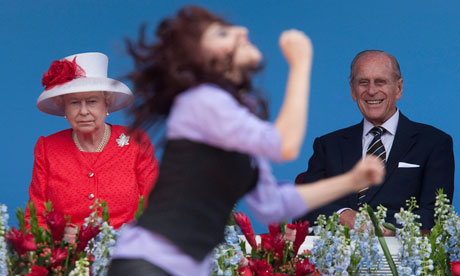
3. The Queen and Prince Philip are in Canada and they're being really boring so no one cares.

4. Will and Kate's nonexistent wedding is still being planned by the media. The two of them went in to buy a frozen pizza a few days ago and Kate had to pay with a credit card because neither one of them carry cash. The whole thing ended up in The Daily Fail; poor dears, they have no privacy.

5. The press says Charles and Camilla are "living separate lives" but it's not true.